Shortform
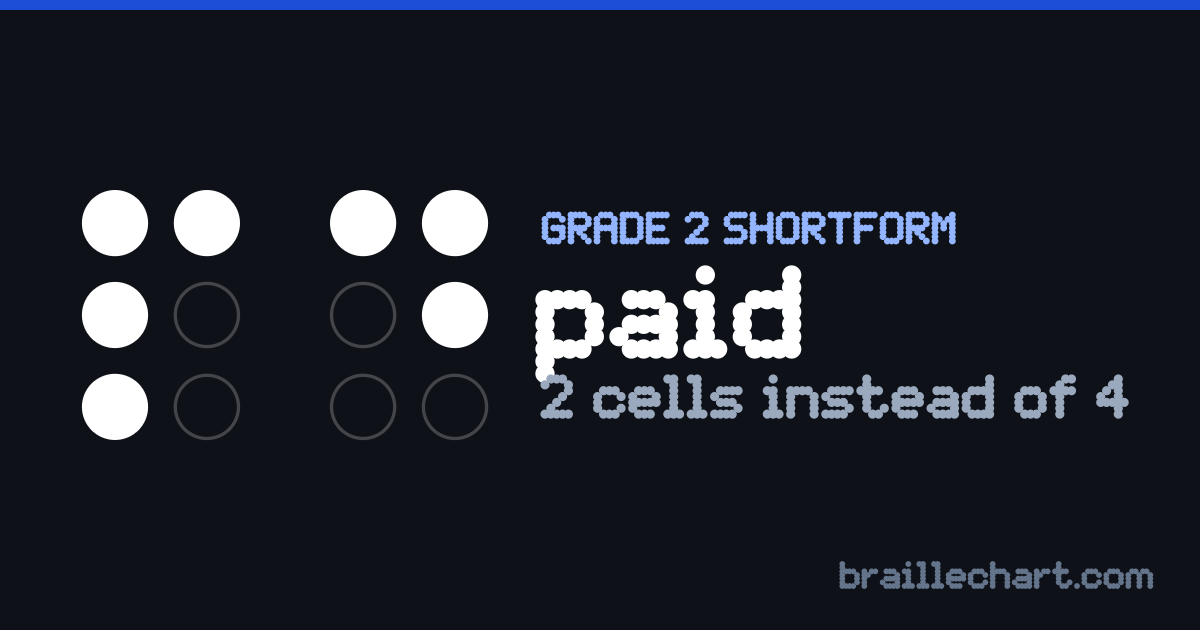
“paid” in braille
Written p-d — 4 letters cut to 2 letters of abbreviation, then written in 2 cells. That is 2 cells saved every time the word appears.
dots 1-2-3-4, then dots 1-4-5
Unicode ⠏⠙ — 4 letters in 2 cells
How to recognise it
p-d in two cells. Eight dictionary words begin with these letters and the reference contracts none of them, so this shortform only ever writes the bare word.
Two steps, not one
Abbreviated in letters first, then written in cells. “paid” loses 2 letters — a, i — to become pd. Every letter of the abbreviation is then written as itself, one cell each.
| Stage | What it is | Cells |
|---|---|---|
| Spelled out | paid | 4 cells |
| Abbreviated | pd | 2 letters |
| Written | 2 cells |
Only an added s keeps it
None of the 8 English words that begin with “paid” keeps this shortform: the reference spells every one out. These 2 cells write the bare word, and with an s added they still stand: “paids” is p-d-s, because a shortform keeps its cells when s is added (Rules of Unified English Braille 10.9.5). “good” is the opposite case — it carries seven different endings.
Words that only look like it
Everything else starting p-a-i-d is unrelated. Each begins with the same letters and is written out in full.
| Word | In braille | Cells |
|---|---|---|
| paideutic | 9 cells | |
| paidle | 6 cells | |
| paidology | 9 cells |
What these 2 cells mean elsewhere
Every cell here has other jobs, which is where misreadings come from:
| Cell | Dots | What it is elsewhere |
|---|---|---|
| 1-2-3-4 | the letter p; the word “people” standing alone | |
| 1-4-5 | the letter d; the word “do” standing alone |
Check your own text
The translator writes “paid” with Grade 2 selected, and the contractions page has all seventy-five.
“paid” in braille as an image
The word as it is actually written: pd in 2 cells, not 4 letters.