Research
Which shortforms can carry an ending?
The usual teaching gives one list of endings for all seventy-five shortforms. Measured against the reference, that list is wrong in both directions.
A shortform is a whole word written with an abbreviated sequence of letters: about as ab, because as bec, braille as brl. There are 75 of them, and the standard treatment adds that a shortform keeps its abbreviation when a common ending is bolted on — friends, goodness, letters.
It is a good rule and it is not quite true. Some shortforms take endings the list does not mention. Others take almost none. And the same three letters at the front of a word can keep the shortform in one word and lose it in the next, for reasons no ending list can express.
Corrected 14 September 2026. This page and this site's shortform list included o'clock, which Unified English Braille dropped, and left out braille, oneself and thyself. The list now holds the 75 shortforms of the ICEB Shortforms List. The measurement below was taken over the old list and has not been re-run: o'clock has no longer words, so it was never among the 51, but braille has longer words and was not measured. Later that day the engine began adding s to every shortform but three, as rule 10.9.5 says; the measured lists in the tables are unchanged.
The method
- Question
- When an English word begins with a shortform and continues, does the reference still write the shortform?
- Compared against
- liblouis 3.29.0 (en-ueb-g2), using its published UEB Grade 2 table. The figures on this page were measured against that release. Since 17 September 2026 the site measures its accuracy against liblouis 3.39.0, and this survey has not been re-run against it.
- Over
- Every word in a large English word list that starts with one of the 73 shortforms this site then listed and is longer than it — 628 words across the 51 shortforms that have any.
- Committed as
forge/topics/braille/data/shortform-stems.tsv
The word list is a full dictionary, so it includes rare and technical words alongside common ones. That is deliberate: the question is what the rule does across English, not across the words someone thought to check.
The result
| Measure | Count | Share |
|---|---|---|
| Longer words tested | 628 | — |
| Keep the shortform | 474 | 75.5% |
| Spell it out | 154 | 24.5% |
Three quarters keep it, which is why the rule is taught the way it is. The interesting quarter is the exception, and the exceptions are not spread evenly.
| Behaviour | Shortforms | What that means |
|---|---|---|
| Always keeps it | 21 | A blanket rule would work for these. |
| Never keeps it | 7 | A blanket rule would work for these too, in the other direction. |
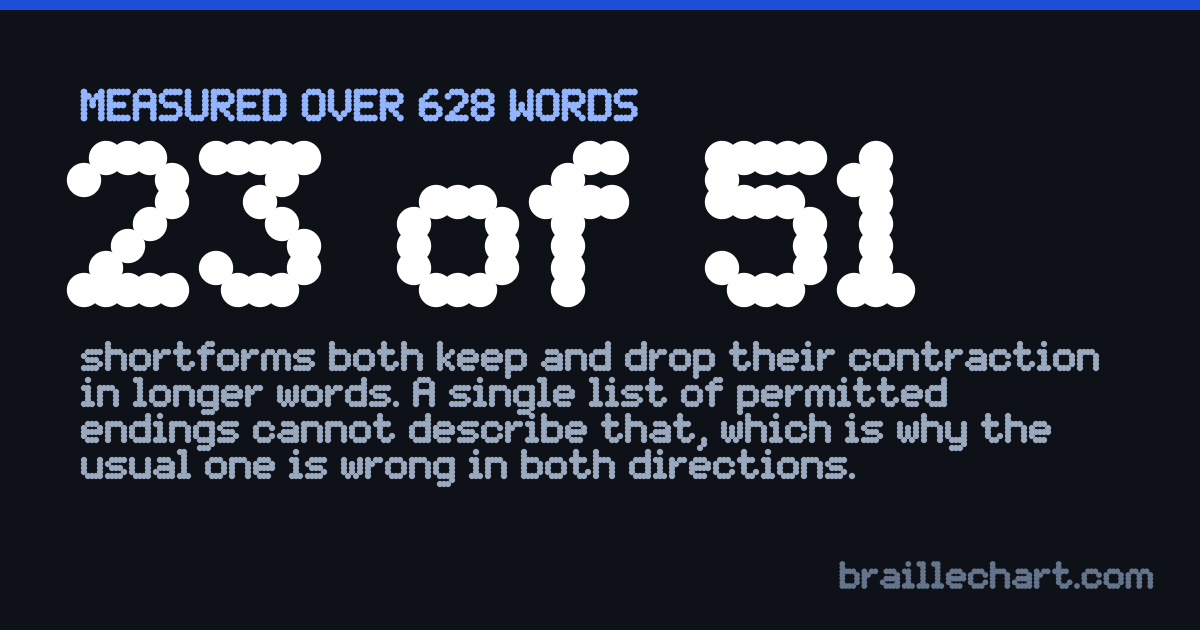
| Both, depending on the word | 23 | No rule about endings can describe these. |
The largest group is the one no single list can handle. That is the finding: for 23 of the 51 shortforms, whether the abbreviation survives is a property of the whole word, not of the ending.
The shortforms the reference is inconsistent about
Lowest first — these are the ones where assuming the shortform carries over goes wrong most often.
| Shortform | Keeps | Of | Keep rate |
|---|---|---|---|
| him | 1 | 22 | 4.5% |
| must | 8 | 49 | 16.3% |
| should | 2 | 11 | 18.2% |
| much | 2 | 10 | 20.0% |
| such | 1 | 5 | 20.0% |
| before | 2 | 8 | 25.0% |
| tomorrow | 1 | 4 | 25.0% |
| could | 2 | 6 | 33.3% |
| today | 1 | 3 | 33.3% |
| would | 2 | 5 | 40.0% |
| your | 3 | 7 | 42.9% |
| above | 4 | 8 | 50.0% |
| beyond | 1 | 2 | 50.0% |
| said | 1 | 2 | 50.0% |
| together | 2 | 4 | 50.0% |
| declare | 4 | 6 | 66.7% |
| perceive | 4 | 6 | 66.7% |
| good | 47 | 58 | 81.0% |
| rejoice | 5 | 6 | 83.3% |
| receive | 6 | 7 | 85.7% |
| letter | 24 | 27 | 88.9% |
| quick | 35 | 39 | 89.7% |
| first | 10 | 11 | 90.9% |
Two pairs are worth sitting with.
must keeps its shortform in mustard and loses it in mustache. Neither word has anything to do with must; the reference treats one as a word that happens to start with those letters and the other as an exception. should keeps it in shouldest and loses it in shoulder — that one at least has an explanation a reader can feel, since shoulder would otherwise open with a sign meaning a different word.
And him keeps it exactly once out of twenty-two: in himself. Every other word in English beginning with those three letters is something like Himalaya.
What this site does with it
Rather than one list of endings for all 75 shortforms, this site's engine carries a measured list per shortform, and one ending the rulebook settles for all of them: an added s. Rule 10.9.5 of the Rules of Unified English Braille keeps a shortform's cells when s is added — becauses is b-e-c-s — except in abouts, almosts and hims, and the reference writes all 75 the same way. With it, 72 shortforms take at least one ending and 3 take none. Across all of them the endings that ever appear number 14.
The direction of error decides how the lists are built. Writing a contraction the reference does not use is wrong braille and a reader is misled; spelling a word out where the reference contracts is longer and correct. So an ending goes on a shortform's list only where the reference actually uses it, and the test that read this data checked one thing above all: that the false-positive count was zero.
| Shortform | Endings | Which |
|---|---|---|
| good | 7 | -s -er -ers -ly -ness -ship -less |
| letter | 6 | -s -ed -er -ers -ing -less |
| great | 5 | -s -er -ly -est -ness |
| quick | 5 | -s -er -ly -est -ness |
| blind | 4 | -s -ly -ness -less |
| first | 4 | -s -ly -ness -ship |
| friend | 4 | -s -ly -ship -less |
| rejoice | 4 | -s -d -r -ful |
| conceive | 3 | -s -d -r |
| deceive | 3 | -s -d -r |
| declare | 3 | -s -d -r |
| little | 3 | -s -r -ness |
| perceive | 3 | -s -d -r |
| receive | 3 | -s -d -r |
| after | 2 | -s -ship |
| immediate | 2 | -ly -ness |
| much | 2 | -ly -ness |
| together | 2 | -s -ness |
| above | 1 | -s |
| according | 1 | -ly |
| afternoon | 1 | -s |
| afterward | 1 | -s |
| behind | 1 | -s |
| below | 1 | -s |
| beside | 1 | -s |
| between | 1 | -s |
| beyond | 1 | -s |
| could | 1 | -est |
| must | 1 | -s |
| perhaps | 1 | -es |
| rejoicing | 1 | -ly |
| said | 1 | -s |
| should | 1 | -est |
| today | 1 | -s |
| tomorrow | 1 | -s |
| tonight | 1 | -s |
| would | 1 | -est |
| your | 1 | -s |
If you are learning these
The practical version is shorter than the research. Use the shortform for the word itself, always. Use it with an ending only when you have seen that combination, or when the ending is an s, which every shortform but about, almost and him keeps — and the page for each shortform now lists the endings measured safe for it, along with the English words that begin with the same letters and do not take it.
The contraction finder will show you what happens to any word you type, including which contractions were legal and passed over. All six write-ups are published with their method and their failures.
The finding, as a card
The one number worth carrying out of this: most of these shortforms do both.