Punctuation
The semicolon in braille
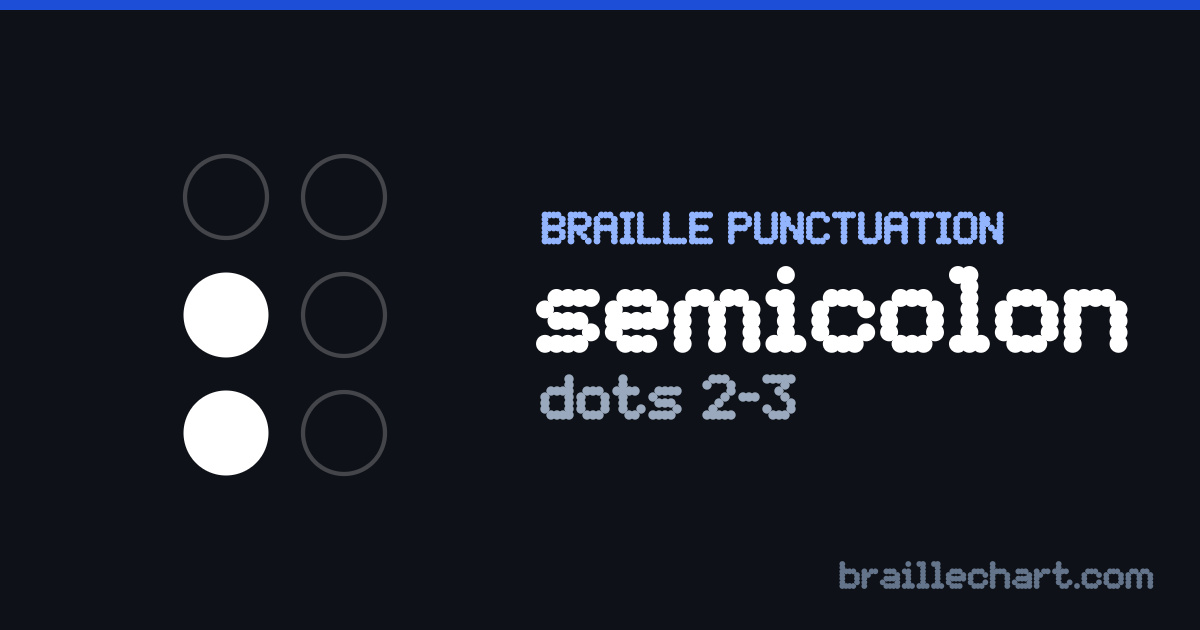
Semicolon is dots 2 and 3 — a single cell.
2-3
One cell — semicolon
How to recognise it
Dots 2 and 3, a short vertical pair low in the cell.
It is the letter b moved down a row
Take the cell for b and slide every dot down one position — dot 1 becomes dot 2, dot 4 becomes dot 5 — and you have the semicolon.
In a sentence
It rained; we stayed in.
In Grade 2, the same cell: Dots 2-3 are also bb, be and the word be
In Grade 2 the same cell has three other readings. Between two letters it is bb (rule 10.6.5): abbé ⠁⠆⠘⠌⠑. At the start of a word, before a letter, it is be (rule 10.6.2): become ⠆⠉⠕⠍⠑. Standing alone it is the word be (rule 10.5.1): to be ⠞⠕ ⠆.
The word sign is not used where it would touch a punctuation mark that has only lower dots (also 10.5.1), so be before a semicolon is spelled out: be; ⠃⠑⠆. And a semicolon where it could be read as one of these takes the grade 1 indicator (rule 7.1.3): standing alone it is ; ⠰⠆.
Marks it is confused with
The semicolon is one dot away from the comma, the question mark, the exclamation mark and the apostrophe.
| Cell | Mark | Dots |
|---|---|---|
| Comma | 2 | |
| Question mark | 2-3-6 | |
| Exclamation mark | 2-3-5 | |
| Apostrophe | 3 |
The semicolon as an image