Punctuation
The question mark in braille
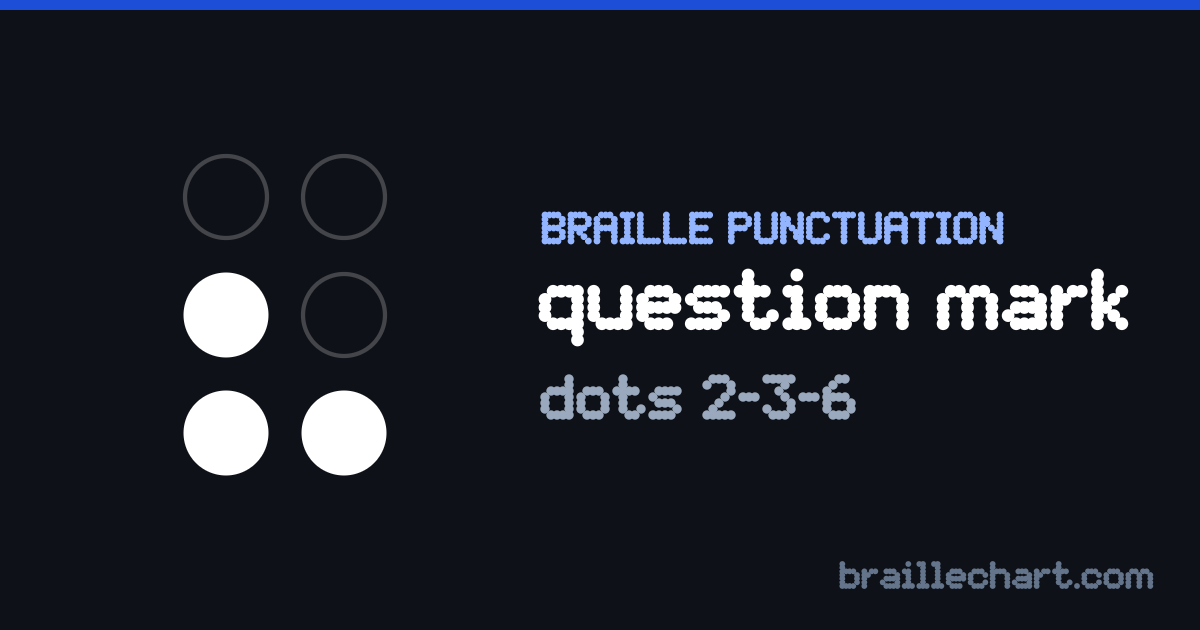
Question mark is dots 2, 3 and 6 — a single cell.
2-3-6
One cell — question mark
How to recognise it
Dots 2, 3 and 6 — the same cell as the opening quotation mark, which is a genuine ambiguity in the code rather than an error in this table.
It is the letter h moved down a row
Take the cell for h and slide every dot down one position — dot 1 becomes dot 2, dot 4 becomes dot 5 — and you have the question mark.
It shares a cell with the opening quotation mark
The question mark and the opening double quote are the same cell in Unified English Braille. Position tells them apart — a question mark follows a word, an opening quotation mark comes before one — and this is a real ambiguity in the code, not an error in the table. It is also why automatic braille-to-text decoding cannot be perfectly reliable: given the cell by itself in Grade 1, the decoder reads a question mark. The closing quote, dots 3-5-6, is unambiguous.
In a sentence
Can you read this?
In Grade 2, the same cell: Dots 2-3-6 are also the word his
In Grade 2 the same cell, standing alone, is the word his (rule 10.5.1): his car ⠦ ⠉⠜. So a question mark standing alone takes the grade 1 indicator (rule 7.5.3), as does one that follows a space, hyphen or dash (rule 7.5.4): ? ⠰⠦. After a word it needs none: his? ⠓⠊⠎⠦, where his is spelled out because the word sign may not touch a mark with only lower dots (10.5.1).
Marks it is confused with
The question mark is one dot away from the semicolon and the hyphen.
| Cell | Mark | Dots |
|---|---|---|
| Semicolon | 2-3 | |
| Hyphen | 3-6 |
The question mark as an image