Numbers
The number 9 in braille
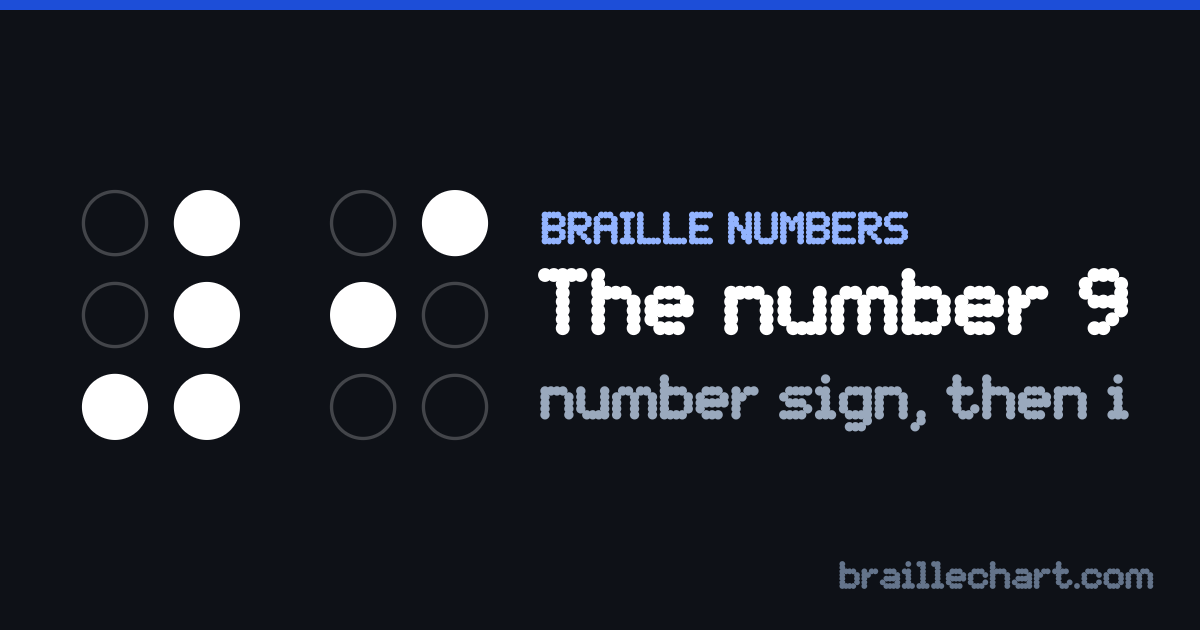
9 is the number sign followed by the letter i — dots 2 and 4.
Number sign + i
Dots 3-4-5-6, then dots 2-4
Why it uses a letter
After a number sign the cell for i reads as 9; without one it is the letter i — see I in braille.
9 inside larger numbers
One number sign covers the whole run: 9, 19 and 900 each take one.
9
19
900
9 in everyday writing
| Written | In braille | What the cells do |
|---|---|---|
| 9 June | a space ends the number | |
| 9.5 | a decimal point does not — no second number sign | |
| 9cm | c is a digit letter, so it takes the letter sign — without it these cells read as “93m” | |
| 9kg | k is not a digit letter, so nothing extra is needed |
Braille numbers sets out the rule behind all four.
What is particular to 9
The same cell with no number sign
It is the letter i. The word “I” is this cell with a capital sign in front of it, ⠠⠊, so ⠼⠊ is 9 and ⠠⠊ is “I”.
9th
9th is ⠼⠊⠞⠓, with t and h as two separate cells. Elsewhere “th” is one cell, but a contraction may not follow a number (Rules of Unified English Braille 6.5.3).
One dot away, and mirrored
After the number sign, 9 is dots 2-4. Add one dot and it is 6 (dots 1-2-4) or 0 (dots 2-4-5). Mirrored left to right it becomes 5 (dots 1-5), which is the shape a slate writer punches for it.
9 in braille as an image
Both cells as a picture: the number sign, then the letter i at dots 2-4.