Shortform
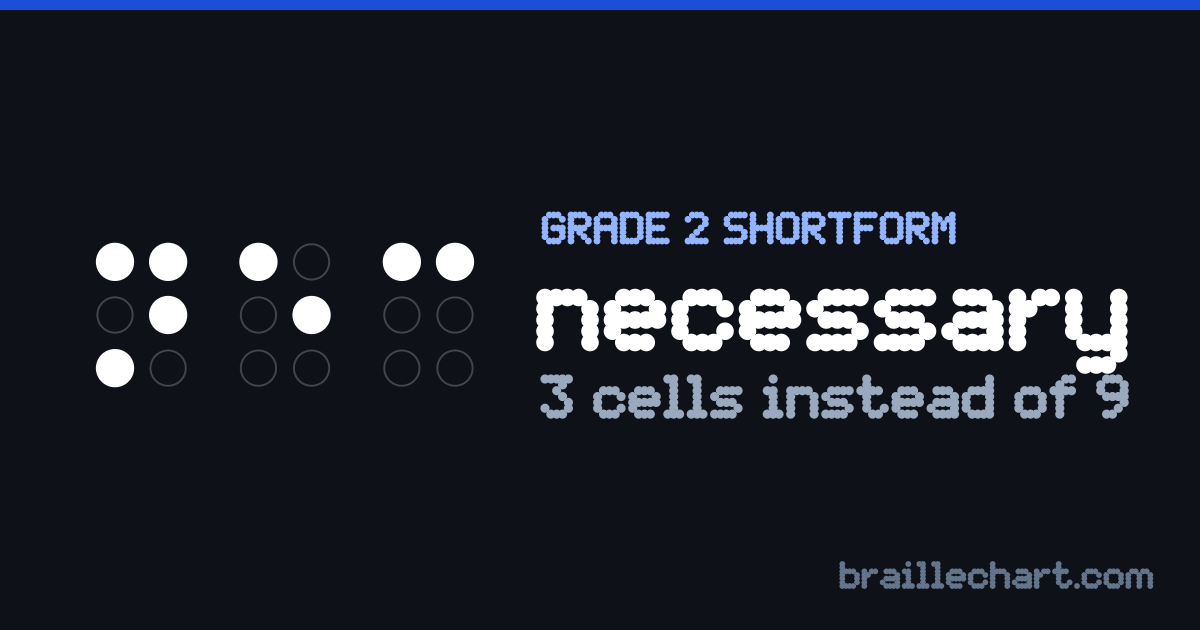
“necessary” in braille
Written n-e-c — 9 letters cut to 3 letters of abbreviation, then written in 3 cells. That is 6 cells saved every time the word appears.
dots 1-3-4-5, then dots 1-5, then dots 1-4
Unicode ⠝⠑⠉ — 9 letters in 3 cells
How to recognise it
n-e-c, nine letters in three cells — the word simply cut short after three. It has no family, no look-alikes and no ending but an added s: nothing else in English begins with these nine letters.
Two steps, not one
Abbreviated in letters first, then written in cells. “necessary” loses 6 letters — e, s, s, a, r, y — to become nec. Every letter of the abbreviation is then written as itself, one cell each.
| Stage | What it is | Cells |
|---|---|---|
| Spelled out | necessary | 9 cells |
| Abbreviated | nec | 3 letters |
| Written | 3 cells |
Only an added s keeps it
No English word begins with “necessary” except the word itself, so there is nothing for an ending rule to decide here. These 3 cells write the bare word, and with an s added they still stand: “necessarys” is n-e-c-s, because a shortform keeps its cells when s is added (Rules of Unified English Braille 10.9.5). “good” is the opposite case — it carries seven different endings.
What these 3 cells mean elsewhere
Every cell here has other jobs, which is where misreadings come from:
| Cell | Dots | What it is elsewhere |
|---|---|---|
| 1-3-4-5 | the letter n; the word “not” standing alone | |
| 1-5 | the letter e; the word “every” standing alone | |
| 1-4 | the letter c; the word “can” standing alone |
Check your own text
The translator writes “necessary” with Grade 2 selected, and the contractions page has all seventy-five.
“necessary” in braille as an image
The word as it is actually written: nec in 3 cells, not 9 letters.