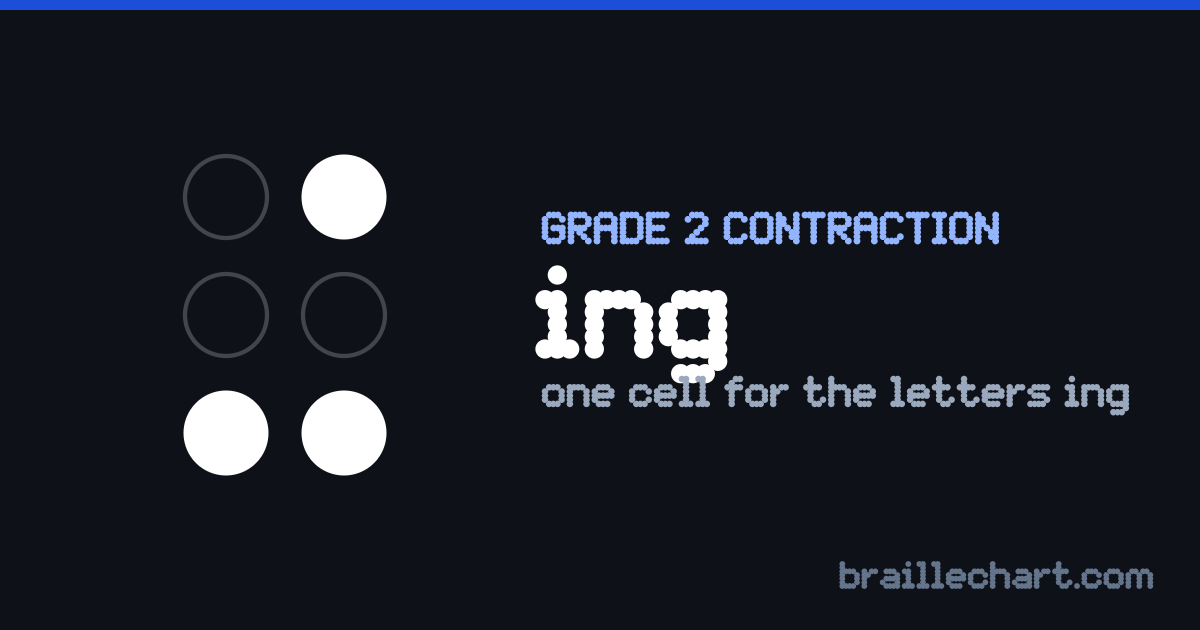
Grade 2 contraction
The “ing” contraction in braille
One cell for the letters “ing” wherever they appear together in a word.
Dots 3-4-6
Unicode ⠬ — replaces the letters ing
How to recognise it
Dots 3, 4 and 6. Three letters in one cell, and one of the biggest single savings in English.
It may not start a word
This is a lower sign — its dots sit away from the top of the cell — and lower signs cannot open a word. At the start of a word the cell would be ambiguous with punctuation, so the letters are written out in full instead.
“ingredient” is written letter by letter even though it begins with these letters, because the contraction is not allowed in that position.
Words that use it
Each of these is shorter in Grade 2 than in Grade 1, because the letters “ing” collapse into a single cell wherever the rules allow it.
| Word | In braille (Grade 2) | Grade 1 | Grade 2 |
|---|---|---|---|
| going | 5 cells | 3 cells | |
| singing | 7 cells | 3 cells | |
| bring | 5 cells | 3 cells | |
| doing | 5 cells | 3 cells |
Where it does not apply
These are the ones that catch people out — words that contain the letters but do not take the contraction. Knowing why is more useful than memorising the list.
| Word | Written as | Why |
|---|---|---|
| ingredient | ing may not open a word, so this one starts with the in sign and a g instead |
Contractions it is confused with
These differ from “ing” by a single dot, which is where reading errors actually happen. Under a fingertip a missing or extra dot is far easier to miss than a completely different shape, so these are the ones worth drilling against each other.
The same cell is a letter in Spanish braille
In Spanish braille this cell is not the “ing” contraction. It is the letter ó — a letter in its own right, one cell, no prefix. Spanish is a separate braille code rather than UEB with accents added, and all seven of its extra letters land on cells UEB has already given to a contraction.
It matters because the failure is silent. Spanish written with the UEB tables produces cells a Spanish reader will read confidently and wrongly, and 18% of the 5,001 commonest Spanish words carry one of these letters — measured, not estimated. The Spanish alphabet and the Spanish translator use the Spanish tables.
Check your own text
Type anything into the translator with Grade 2 selected and this cell will appear wherever the rules allow it. The full contraction list shows the other eighteen, and Grade 1 versus Grade 2 explains when contracted braille is the right choice at all.
The “ing” cell as an image
One cell — dots 3, 4 and 6 — as a picture for a handout or a slide.