Grade 2 contraction
The “gh” contraction in braille
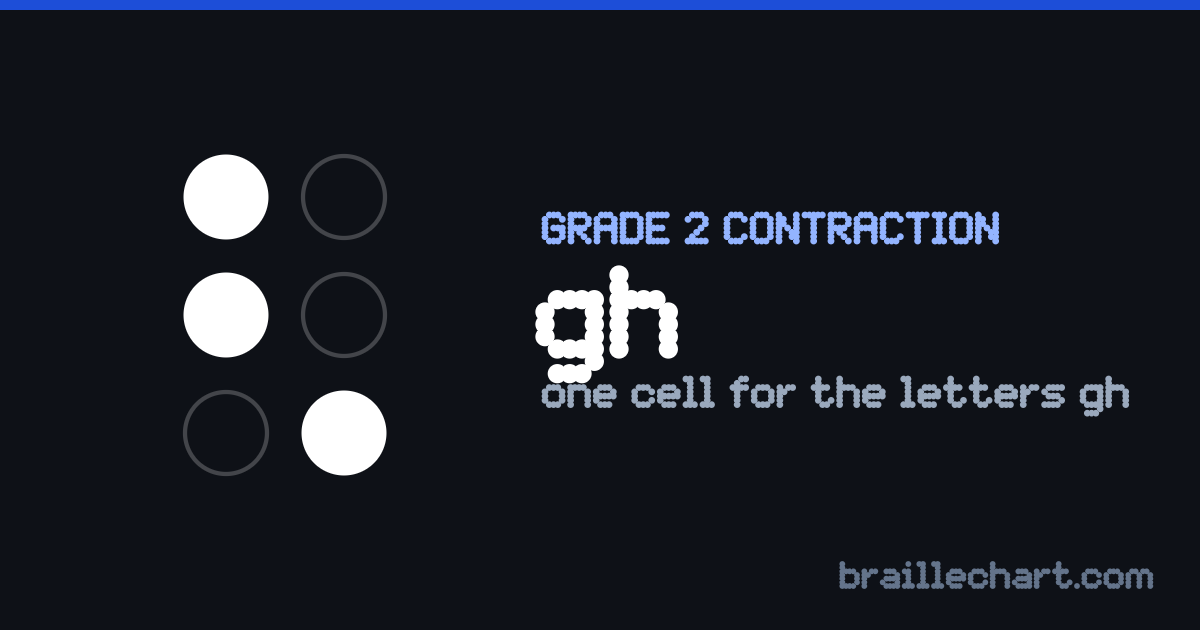
One cell for the letters “gh” wherever they appear together in a word.
Dots 1-2-6
Unicode ⠣ — replaces the letters gh
How to recognise it
Dots 1, 2 and 6, for g and h together, as in “might” and “high”.
Words that use it
Each of these is shorter in Grade 2 than in Grade 1, because the letters “gh” collapse into a single cell wherever the rules allow it.
| Word | In braille (Grade 2) | Grade 1 | Grade 2 |
|---|---|---|---|
| night | 5 cells | 4 cells | |
| though | 6 cells | 3 cells | |
| laugh | 5 cells | 4 cells | |
| rough | 5 cells | 3 cells |
Where it does not apply
These words contain the letters but do not take the contraction.
| Word | Written as | Why |
|---|---|---|
| bought | the whole of “ought” has its own two-cell contraction, which is shorter than ou plus gh |
Contractions it is confused with
These differ from “gh” by a single dot.
In a whole book
In a count over the whole of Alice’s Adventures in Wonderland (26,439 words), this contraction is written 134 times and saves 134 cells. That is 0.39% of everything Grade 2 saves in the book, and ranks it 62nd of the 158 contractions used.
The words it is written in most: might (28), high (16), though (11), sight (10), enough (7) — 35 different words in all.
Check your own text
Type anything into the translator with Grade 2 selected and this cell will appear wherever the rules allow it. The full contraction list shows the other eighteen, and Grade 1 versus Grade 2 explains when contracted braille is the right choice at all.
The “gh” cell as an image
One cell — dots 1, 2 and 6 — as a picture for a handout or a slide.